
Single Post
You can teach belonging. You can design the workshops, cite the frameworks, hold the space — and still come home to an apartment that doesn’t yet know your name.
That’s not irony. It’s just how expertise works. It gives you the language before it gives you the life.
After 18 years in L&D, I can walk into any room and build psychological safety in under an hour. I know Baumeister and Leary’s belongingness hypothesis well enough to explain it to a sceptical CFO. I’ve run sessions on social connection for teams across the GCC, watched people who hadn’t spoken honestly in months find each other across a conference table.
Then I moved to Dubai.
What I didn’t account for was how thoroughly knowing about something prepares you to teach it — and how completely it fails to protect you from needing it. Forty years of roots in Bangalore means cafes meant people, conversations that sprawled across hours, the particular ease of being known without having to explain yourself first. One year in Dubai: same cafe habit, different reality. Just me, my coffee, and the specific quiet of a city that doesn’t know your history yet.
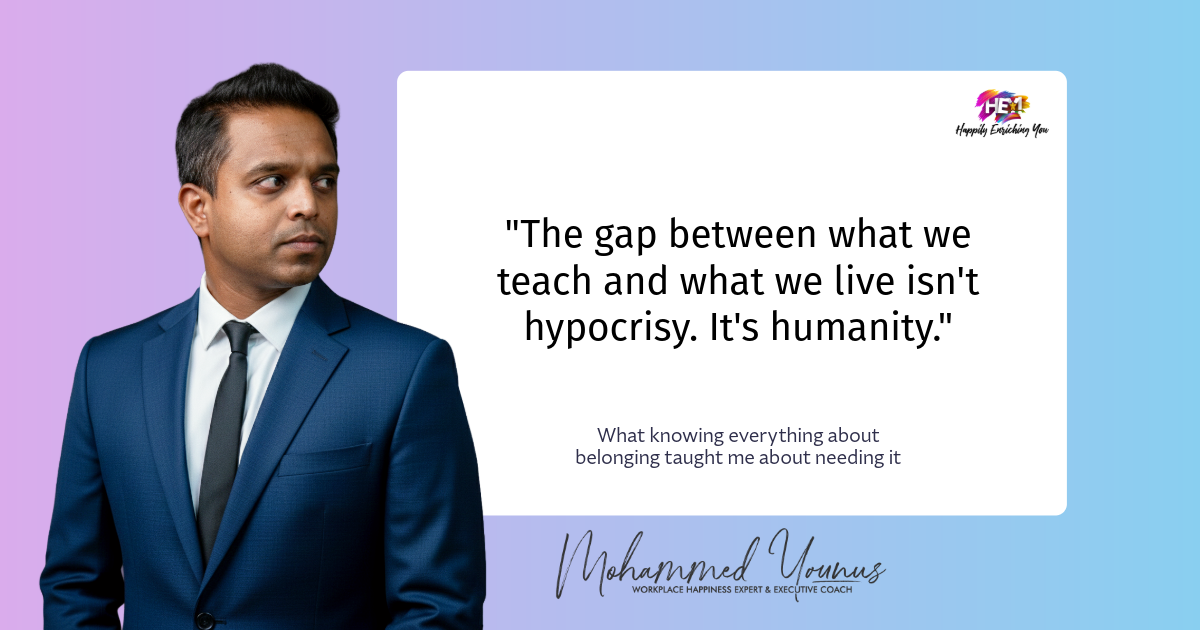
Here’s what that exposed: the gap between what we teach and what we live isn’t hypocrisy. But it isn’t neutral, either. It’s the thing most of us in L&D, coaching, and HR quietly carry — and almost never name.
When Expertise Becomes a Kind of Armour
The belonging gap in professional well-being
The standard framing is that practitioners need to “walk the talk.” Apply your own frameworks. Model the behaviour you facilitate. And there’s truth in that — but it’s also a trap. Because it implies that struggling with the very thing you teach is a failure of consistency. A credibility problem. Something to resolve before you’re seen again.
So we don’t name it. We keep the workshop polished and the personal life private. We facilitate psychological safety while navigating our own belonging challenges alone, because the professional distance feels safer than the exposure.
In GCC organisations specifically, this pattern runs deep. The culture rewards competence and expertise. There’s a particular kind of professional credibility — built carefully across relationships, seniority, and cultural respect — that practitioners don’t want to risk. Vulnerability isn’t easily separated from weakness here. And so the gap widens. The facilitator becomes more skilled and more isolated simultaneously.
What that costs
It costs presence. Not the performance of presence — the real thing. When a participant says “I feel like nobody here actually sees me,” the practitioner who has lived that recently responds differently than one who learned it from a book. Not more emotionally — with more precision. With the specific texture of someone who knows what that sentence is trying not to say.
The Stoic practices help. Positive psychology tools work. Purpose anchors you through the long afternoons. But they don’t replace sitting across from someone who knows your history without explanation. And the moment you stop pretending otherwise, something in your facilitation shifts.
The both/and the profession doesn’t teach
Professional excellence and personal struggle are companions, not contradictions. The most credible coaching work I’ve done has come from periods when I was, simultaneously, figuring something out. Not despite that — because of it. The messy middle isn’t a detour from good practice. It’s where most human beings actually exist, and the practitioner who can hold that space without needing to resolve it is rarer and more useful than one who can only operate from the resolved end.
Your clients don’t need someone who transcended struggle. They need someone who can stay in the room with them while it’s happening.
That’s the thing expertise doesn’t advertise: the credential is entry. The living is the work.
Where this gets complicated
Because it asks something specific of you. Not to perform struggle — that’s its own trap, and participants recognise it instantly. But to stop requiring resolution before honesty. To let the expertise coexist with the question mark.
I still count the hours until my wife Ayesha comes home from work some days. I still notice the particular quality of being new somewhere — the social translation fatigue, the calibrating, the slow accumulation of context that doesn’t yet feel like home. The tools work, and the ache is still real.
Both are true. Monday morning happens every week.
A Client Story That Almost Didn’t Happen
Last year, an L&D head at a mid-sized logistics firm in Dubai asked me to run a well-being series for their team. Before we could start, she pulled me aside: “I need you to know I’m not okay with the team seeing this as therapy. The moment it looks soft, I lose the room.” She wasn’t being obstructive. She was being accurate. The culture there ran on performance and professional distance — and she’d worked hard to earn standing in it.
We redesigned the entry. Started with language that spoke to performance, not wellness. Named the business cost of disconnection before we named the human one. It worked — not because we hid the real point, but because we met the resistance honestly instead of trying to dismantle it.
Halfway through the third session, she shared something with the group. Not a breakthrough moment — a quiet observation about how lonely good leadership can feel. The room went very still.
What still surprises me: she told me afterward that she hadn’t planned to say it. She said, “I didn’t even know I’d been holding that.” The framework didn’t unlock it. The permission to be in the messy middle did.
Two Questions to Sit With
Where in your professional life are you teaching something you’re also quietly struggling with — and what would it cost to name that, even once?
When you design a well-being or belonging initiative for your organisation, whose belonging are you not including in the plan?
The gap between what we teach and what we live isn’t something to close. It’s something to work with honestly. That’s not a consolation — it’s a different and more useful kind of credibility. The one that keeps you in the room when it gets hard.
If this landed somewhere specific for you, I’d be glad to talk. Reach out here.
