
Single Post
Why It Works Better Than Generic Wellbeing Programs in UAE Workplaces
Most HR directors I meet in Dubai can tell me how many wellbeing initiatives they’ve launched. Very few can tell me whether their employees are actually flourishing.
That gap — between counting activity and measuring impact — is exactly where generic wellbeing programs fail. And it’s exactly where the SPIRE model begins.
What Most Wellbeing Programs Get Wrong
Walk into any large organisation in the UAE right now and you’ll find some version of the same thing: a wellness app, a mindfulness session during Ramadan, maybe a mental health awareness week in October. Tick the boxes. Send the email. Move on.
These programmes aren’t malicious. They’re just built on the wrong question. They ask: “What wellbeing activities can we offer?” instead of “What does it actually mean for a human being to thrive?”
The result is wellbeing as a benefit catalogue. Employees can access it. They rarely feel it.
The SPIRE model, developed by Dr. Tal Ben-Shahar at Harvard’s Positive Psychology programme, asks the harder question. Not what to offer — but what human flourishing is actually made of.
The Five Dimensions of SPIRE
SPIRE is an acronym that maps five interconnected dimensions of wellbeing. What makes it clinically useful — and practically different from generic programmes — is that it treats wellbeing as a whole-person system, not a collection of perks.
S — Spiritual Wellbeing
This isn’t about religion. In the SPIRE framework, spiritual wellbeing means the sense that your work carries meaning beyond the transaction. That what you do matters to something larger than your next performance review.
In GCC workplaces — where many professionals are far from home, navigating cultural adjustment, and working in high-pressure environments — this dimension is chronically underaddressed. The question isn’t whether employees are productive. It’s whether they feel their work is worth producing.
P — Physical Wellbeing
Most organisations focus here because it’s the easiest to measure: gym memberships, step challenges, sleep hygiene workshops. SPIRE doesn’t dismiss this — physical health is foundational. But it repositions physical wellbeing as energy management, not just absence of illness.
The distinction matters. An employee who runs five kilometres every morning but works a 70-hour week with no recovery time isn’t physically well. They’re physically compensating.
I — Intellectual Wellbeing
SPIRE defines intellectual wellbeing as the experience of genuine curiosity and challenge in your work. Not just learning for compliance, but growth that’s intrinsically motivating.
In practice, this is where many mid-career professionals in the UAE quietly disengage. They’ve mastered their role. The challenge has become routine. They’re competent — and bored. Intellectual wellbeing deteriorates not from difficulty, but from the absence of it.
R — Relational Wellbeing
This dimension addresses the quality of professional relationships — not just whether people “get along,” but whether employees feel genuinely seen, valued, and connected at work.
Post-pandemic, relational wellbeing has become the most fragile dimension in hybrid UAE workplaces. Technically connected. Often relationally distant. The difference between a team that functions and a team that trusts comes down, consistently, to this layer.
E — Emotional Wellbeing
The final dimension isn’t about being happy. It’s about the capacity to experience a full range of emotions — including difficulty — without being overwhelmed by them. Psychological resilience, in other words. Not the absence of hard feelings. The ability to move through them.
Why the Model Works Differently in UAE Workplaces
Generic wellbeing frameworks assume a fairly uniform context. SPIRE’s multi-dimensional structure makes it adaptable — which is exactly what’s needed in GCC workplaces, where you might have 40 nationalities on one floor, a hybrid work culture still finding its shape, and significant variation in what employees need to feel genuinely well.
When I apply SPIRE diagnostically — through team assessments or leadership coaching — what almost always surfaces is that the weakest dimension isn’t the one the organisation has been addressing. Companies invest in physical and emotional wellbeing (the visible, measurable ones) while spiritual and relational wellbeing quietly deteriorate underneath.
The practical value of SPIRE isn’t that it’s more comprehensive. It’s that it tells you where to look — and what you’ve been missing.
From Framework to Practice
The most useful starting point for any HR team is a SPIRE-based diagnostic: mapping which of the five dimensions are thriving in your organisation and which are quietly eroding.
What tends to surprise leaders — even those who’ve worked with wellbeing frameworks before — is how rarely the presenting problem is the actual problem. A team struggling with burnout often has a spiritual wellbeing issue at its core. A leadership group reporting disconnection is almost always dealing with relational wellbeing breakdown, not poor communication skills.
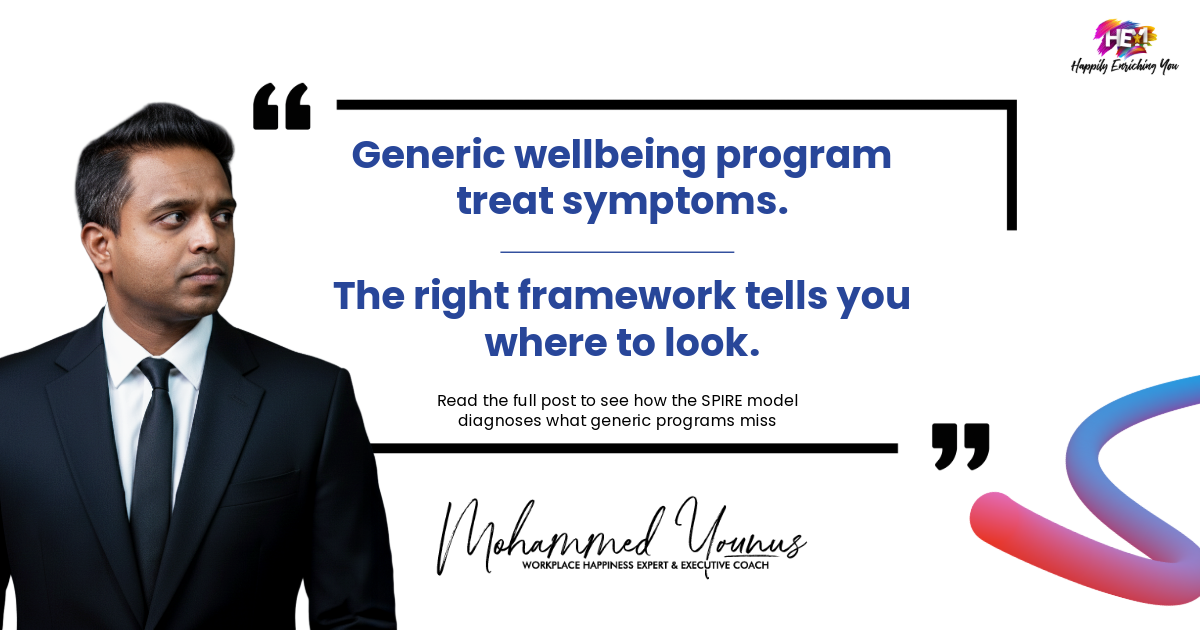
Generic programmes treat symptoms. SPIRE gives you a map.
Starting Points
If you’re an HR or L&D professional evaluating whether SPIRE fits your context, here are two questions worth sitting with:
Which of the five dimensions does your current programme actively address — and which does it assume will take care of itself?
When your employees disengage, which dimension are they describing — even if they don’t have the language for it?
The organisations that get wellbeing right in the UAE aren’t the ones offering the most. They’re the ones who understand what their people actually need to flourish — and build programmes around that, rather than around what’s easiest to measure.
SPIRE doesn’t make wellbeing simpler. It makes it honest.
I work with HR and L&D teams across the UAE and GCC on evidence-based approaches to employee wellbeing and leadership development. If you’re evaluating your organisation’s wellbeing strategy, get in touch.
